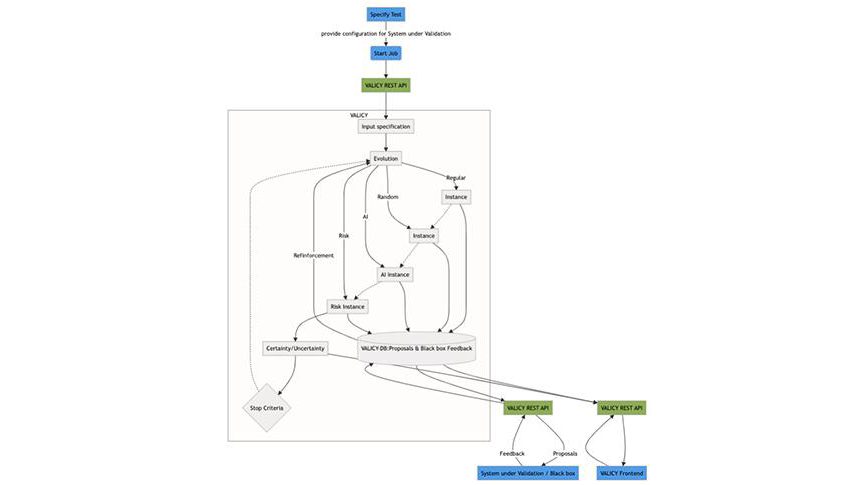
After all grid points are provided a result, the VALICY testing evolution starts with a set-up of competing AI configurations (along with some randomized parameter combinations) that obtain the evaluated points coming from the black box feedback runs. A VALICY job runs an evolution_controller (evolution box in figure) that spawns all the AI and other instances, manages data flow and training of corresponding job runs. At the moment, the pre-setting of competing instances is set from 3 up to 5. Depending on the problem under test, these values can be altered. A newly created AI instance always has a classification method (xgboost, randomForest, ANN) that will remain within a chain of evolution. E.g. if a XGBoost classifier is created, it will only be possible to pass an XGBoost configuration to its descendants. An instance will be fitted to all previously evaluated results. According to our hyperparameter variation setting in the box below, one can see which possibilities for a configuration are possible.
{“xgb”: [{“name”: “xgb_num_round”, “values”: list(range(10,100,10))},
{“name”: “max_depth”, “values”: list(range(2,11,1))},
{“name”: “learning_rate”, “values”: list(np.divide(range(1,101,9),100))},
{“name”: “objective”, “values”:[“binary:logistic”,”binary:hinge”,”binary:logitraw]}]}
We will constantly extend, evaluate and if reasonable, remove the degrees of freedom from the configurations.
A configuration can be AI based or random based. For an AI instance configuration VALICY has an internal evolutionary algorithm that can pass a successful configuration to its children. That means the Method of classification is always preserved during inheritance only hyperparameters are tuned. When a run is created (by an AI) all previously evaluated points are used as training set. New points that are proposed by an AI instance always try to identify points close to a decision boundary. VALICY also makes an internal guess what the black box feedback is assumed to be and takes this rating to determine if a configuration was successful, or not. The more successful the higher the scoring in VALICY. Every 10th run (a pre-set VALICY internal configuration parameter), a random or risk instance is started that arbitrarily places points within the test space. This serves two purposes, first to not get stuck once a transition of true/false is identified and secondly, that the points created by the AI instances are not biasing the certainty estimation result (AI results tend to be close to the decision hyperplane). A risk instance is estimating the achieved certainty by first placing samples in the under-sampled volumes applying a geometrical approach with inverted distances.
VALICY runs on dedicated servers in docker containers. If more nodes are needed, more cores can simply be added to the computational cluster. As the standard configuration is three instance runners and one evolution runner, the adding of nodes is performed in batches of 4 (, otherwise 1 evolution runner + number of instance runners per evolution runner).
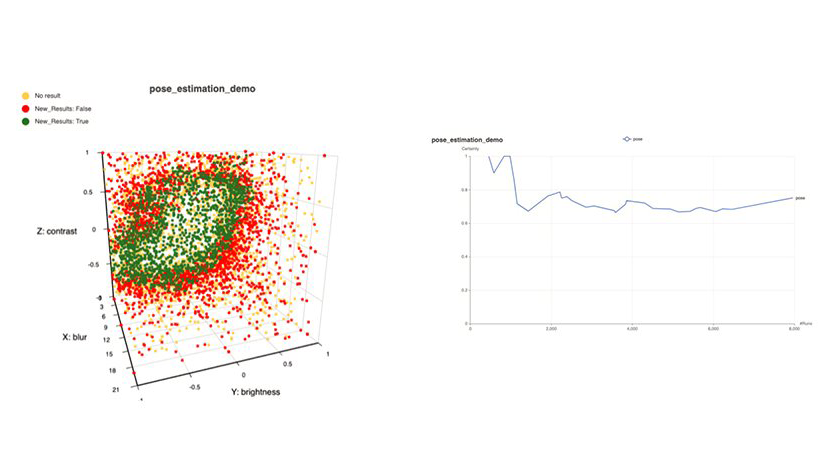
For inspection of results, a front end allows to inspect the results, see the distribution of test proposals along with the evaluated results, and gain some insights. This is a work in progress, we regularly update it, when new features become available.
To monitor the operation of VALICY, Grafana dashboards are used.
The VALICY customer communication always uses the VALICY Rest API for a standardized and secure communication. After full virtual validation run, the resulting certainty is available along with all the run results.
Lately, we added clustering of the results for both True and False points. Clustering is done applying Gaussian Mixture Models (default), but kmeans can also be used. For the clusters we also provide characteristics like, number of points per cluster, volume (multidimensional), fraction of points on the outer silhouette, clusters with an overlap and its percentage, outliers of the clusters etc.